
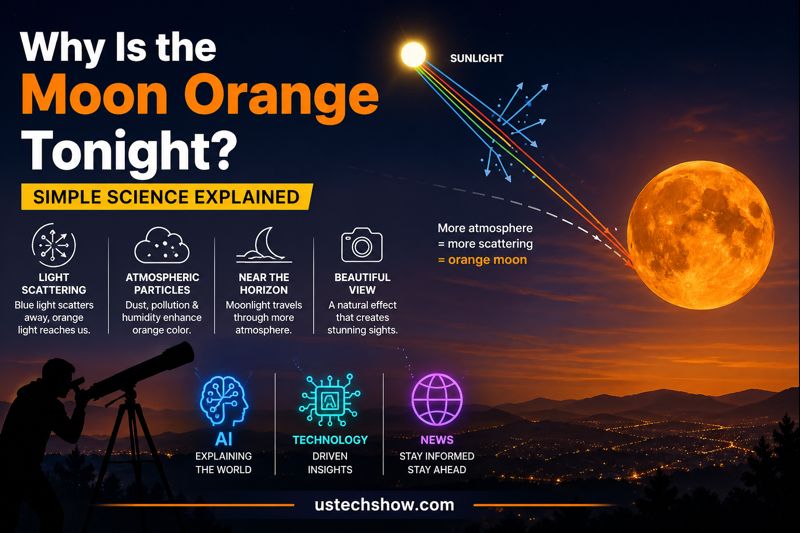

Do you remember a time when you looked at the night sky and saw the moon shining bright with a surprising orange color? It’s a beautiful view that everybody can enjoy. But what really makes this happen? Tonight, as you look to the skies, you may be curious: why is the moon orange tonight? This hypnotic event isn’t only about visual appeal – it’s rooted in science and atmosphere. Come along as we delve into the intriguing causes of this colourful lunar show and find out what makes every one of these different!
What Causes the Moon to Appear Orange at Night?
Color of the Moon can change a lot by many factors. When the moon looks orange, it’s usually due to light being scattered by the atmosphere of the Earth,
The moonlight rays travel through a thicker layer of air that can be found at the horizon, and the shorter blue wavelengths are scattered away and the color we receive is a warmer one, that is yellow and orange. That is the very effect we are observing when the Sun is rising and setting.
And the atmosphere is just as important. High humidity or presence of particles in the air (dust, pollution, etc.) will intensify the coloration as light is diffused more.
This distance and atmospheric interruption between us and the moon all combined cause our lone satellite to become a breathtaking show that everyone should take notice of. So when that orange moon rises tonight, just know you’re not imagining colors — it’s just Mother Nature painting the night sky with a few more vibrant hues!
Main Reasons Behind an Orange Moon Tonight
There are several interesting reasons why the moon appears orange. One big factor is the moon’s position in relation to our horizon. When it is rising or setting, a greater portion of Earth’s atmosphere lies between the observer and the Sun that the light must pass through.
In the meantime, shorter wavelengths scatter known as longer ones. This natural phenomenon contributes to letting us seeing the red and orange colours.
Seasons do contribute somewhat. At certain times of year, these atmospheric conditions can be favorable.
In addition wildfires or dust storms can send particles into the air that add to these colors even more. The influence of pollutants is also felt by changing light’s interaction with the many constituents of our atmosphere.
This is what the combined effects of all these things contributing to that incredible orange glow in the sky that we watch to on a clear night!
How Earth’s Atmosphere Changes Moon Color
Because Earth’s atmosphere distorts the light, the color of the moon we see is not the real color of the moon. When you look at an orange moon, you’re not just seeing things — the color is caused by conditions in the atmosphere.
The air through which moonlight travels is full of particles and gasses. They too scatter the shorter wavelengths of light (blues and violets) more so than the longer wavelengths (reds and oranges). This above scattering hides some colors from eyes while it makes us aware with more colors.
When the moon is close to the horizon, at moonrise and moonset, you are looking through more air to receive its light than when the moon is overhead. This extended path builds up the orange color we “see”. The result is a breathtaking show that on some nights can excite even the most jaded stargazer.
Knowing all this makes me realize how much the earth is tied to the stars above. It ferments every gaze at an orange moon, and now every gaze at an orange moon got a little more special.
The Science of Light Scattering and Moon Colors
The scattering of light is a fascinating phenomenon and is mainly the reason why we see a coloured moon. As sunlight passes through Earth’s atmosphere, it collides with molecules and small particles.
The result is that shorter wavelengths of light (blues and violets) scatter more than longer wavelengths of light (reds and oranges). So when you gaze at that orange moon rising above the horizon, you’re actually seeing this cool trick of light.
The cooler option with off-white IV.. It is the blue light that has been filtered out by the thicker atmosphere. And what you get instead are those warm tones that we associate with sunsets and sunrises.
The funny thing about this phenomenon is that it changes with air phenomena, such as humidity, or pollution concentration. For instance, you might see a brighter orange on a clear night than on a night when there’s a haze or dust that can dim its light.
Why the Moon Looks More Orange Near the Horizon
When you observe the moon at just above the horizon, it is more orange than when you look higher in the sky. It has to do with the way we perceive color and light.
Since the moonlight is traveling through the earth’s atmosphere while it is rising or setting and at that time the light of the moon travel through more atmosphere. This strata is more dense, and the superiorscatter at shorter blue wavelengths, which means longer red and orange wavelength penetrate through.
Marina for example removed the bottom braces in her design and glass light diffused this to really warm tones that are really stunning. Foreign bodies particles are themost frequent triggers of that fiery reaction.
Also, sight has something to do with it objects on the horizon are placed against terrestrial landmarks, and so they appear larger and more colorful than when they are suspended in the sky. It’s an optical illusion, but one that will make your nighttime —– and daytime ––– view even more magical.
Is an Orange Moon a Sign of Weather Changes?
An orange moon can actually raise curiosity for weather changes in the near term. It is a common folk belief that a bright coloured sky foretells changes in the weather.
It is caused by particles such as dust or water vapor that are suspended in the air. These substances diffuse light and make the moon more orange.
The upshot of this is that you might reasonably associate an orange moon with rain or storms on the way. It is a belief based on centuries of observation and folklore.
Now, there’s some truth to that—moisture does affect visibility—but it’s not a good way to predict the weather. The change in color is more related to the way light is scattered in our atmosphere than an direct indication of a change in weather conditions.
So an orange moon may provide a magical nighttime scene, but that’s not necessarily a sign to take out your umbrella just yet!
Difference Between Orange Moon and Blood Moon
The phrases “orange moon” and “blood moon” can be confusing. Although they may be similar in name, they mean very different things in science.
An orange moon usually refers to the color of the moon when you see it near the horizon. This is caused by light being scattered by the atmosphere of the Earth. Dust, pollution or humidity can intensify that warm glow as well.
Meanwhile, a blood moon is associated with a particular lunar event – a total lunar eclipse. Earth is directly between the sun and the moon during this event. The sunlight that is filtered through our world’s atmosphere is what gives the shadowed side this reddish hue.
The colors of both moons are stunning at night, but the two moons come about through different natural phenomena. What makes them different is that you can appreciate them both so that you can appreciate the differences in these phenomenal celestial displays.
Does Pollution or Dust Affect the Moon’s Color?
Pollution and dust can definitely affect the way we see the colour of the moon. When concentration of particle in the air is high, they scatter light in a different manner.
For example, smoke from wildfires or pollution from cities can produce an atmospheric haze. This haze exaggerates the orange of the moon when the moon is near the horizon.
As light passes through these particles, shorter wavelengths are scattered more than longer ones. And so we’re seeing a preponderance of warm colors, reds and oranges, so that’s really what’s making it to our eyes.
Dust storms also contribute to the moon’s color changes. They dimming the opacity of the atmosphere, and thus that fiery orange-glow in the nighttime.
The next time you find yourself looking at that amber moonlit sky, just know that maybe, just maybe, your world has contributed a little something extra for you to look at!
How Moon Phases Influence Its Appearance
The Moon has phases analogous to the phases of the Sun it appears to change shape in our sky from a curved small crescent moon to full moon. Each weird and wonderful phase has an effect on how we see it color and brightness.
It is all but invisible in the night sky at new moon. Slices of light appear as it wax. Atmospheric “ripeness” may be just right for these slow seasonal changes in how dark an orangey-yellow appears.
On a waxing gibbous or full moon, the light is often scattered less because it is high above us. This may mean that the colors are unexpectedly rich or dreary when you find them near the horizon.
Whether its’s a waning moon or a full moon rich orange hue be hard to get away again. The interaction of these two phases means that stargazers (and star curious bystanders) get a different show every month.
When Should You Expect to See an Orange Moon?
If you want to observe an orange moon, you have to be in the right place at the right time. They are usually seen in certain stages of the lunar cycle.
The harvest moon and hunter’s moon in late summer and fall appear to be the best bets. During these evenings, the full moon appears to be rising as the sun is setting, which adds to its color.
The Season affects it all too. As the air cools in fall and early winter, it can enhance atmospheric effects that change colors.
Place some thing like that. Though towns and cities tend to be more light-polluted, breathtaking views can still be found in a certain weather.
Common Myths About Orange Moons Explained
Many are superstitious that an orange moon foretells of disasters to come and other strange things. This is a myth probably originated from folklore and superstition and there is no scientific data that can prove these claims. An orange moon is simply due to the atmosphere.
You’ve heard other old wives’ tales like the moon turns red because of wildfires. Yes, smoke can affect how we see the color of the moon, but it’s not why the moon is orange.
“Some go so far as to say an orange moon means the moon is moving phases or the stars are aligning.” In fact, all moons have shades which vary depending on where they are and what conditions they are under – no ghosts or ghouls here.
It’s one of those things people just consider Halloween-y, like skeletons and bats. It certainly enhances the autumnal nighttime charm, but the association between the two has more to do with the traditional seasonal activities than anything astronomical.
Quick Summary: Why the Moon Turns Orange
How to skywatch The bright orange moon was lovely to gaze at. It is caused from light scattering in the Earth’s atmosphere, which is the same reason that sunrises and sunsets are red and orange. Pollution, dust and even weather can alter the mooon’s color.
When the moon is near the horizon, its light travels through more of the earth’s atmosphere than when it is overhead. This longer path length enhances scattering and is responsible for the more vibrant and orange color of the Moon.
An orange moon is not only beautiful, but you can tell there may be a change in weather from the environmental factors that bring about the color of the moon. This is not to be confused with a blood moon - which has a rather specific astronomical definition related to lunar eclipses.
Next time you glance skyward and behold an orange moon rising over the horizon, you’ll be able to appreciate why it looks so enchanting as it drifts along that dark canvas — because it’s nature’s way of throwing a colorful light show with the Earth’s atmosphere and celestial bodies. The appeal of an orange moon is not just when it’s pretty, but when the science behind this breathtaking event is as well.
FAQs
Why does the moon sometimes look more orange than usual?
The moon can appear more orange when its light passes through thicker layers of Earth’s atmosphere, especially near the horizon, which filters out blue light and enhances warm colors.