
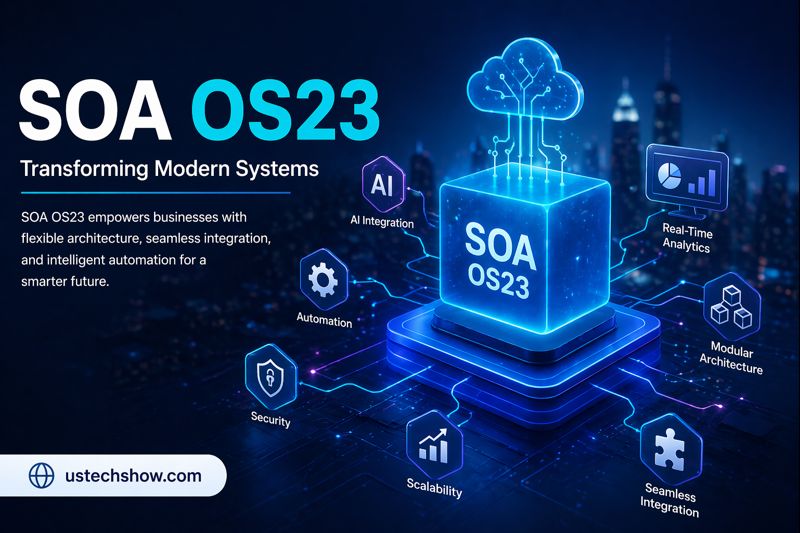

Amid a digital revolution, the need for better and more intelligent solutions for the business of IT remains paramount. SOA OS23, a new paradigm for OS, is introduced and is part of the technology that underlies WARD. As new ways of doing business the processes are transforming the improving new ways of doing business, new ways to streamline procedures, collaborate and provide better customer-centric business.
If you’re either a tech guru or an industry pro, learning about SOA OS23 can open up a treasure chest of opportunities for your company. In the blog post, we will have a closer look into the core of SOA OS23 – what it is, how it works, its primary benefits, and why it is the preferred option for SMEs across all industries. Buckle up, because we’re about to show you how this revolutionary framework is changing the game in today’s connected world!
Understanding SOA OS23 and Its Core Purpose
SOA OS23 is an acronym for Service-Oriented Architecture Operating System 23 and is a new way for systems to interact. At its core, SOA OS23 is about modularity and scale. This enables different services to interact with each other without being tightly coupled.
The main goal of SOA OS23 is to improve the communication between different software systems. Because processes are defined as smaller services rather than large applications, companies can respond faster to evolving demands without rewriting the entire solution.
It’s no surprise that this appeal to developers and businesses is because it drives innovation. They are able to bring new products or services to the market faster, making the most of new or updated technologies with less disruption. In addition, the SOA OS23’s scalability allows the infrastructure of an organization to grow effortlessly along with the organization itself as the demand expands.
Focusing on reuse and performance, SOA OS23 solves many problems traditional system architecture is confronted with today.
An Overview of How SOA OS23 Functions
SOA OS23 is designed in a modular way, so different systems can be effectively communicated. This architectural style enables developers to decompose applications into smaller, loosely coupled services that can be developed and deployed independently. Every segment has a role to play, and none of them can stand alone.
These components have excellent APIs for exchanging data. This all adds up to huge flexibility when it comes to combining different technologies and ways of doing business, and not having to scrap the system.
In addition SOA OS23 is designed to support real-time processing so enterprises can react instantly to emerging demands or Problems. It is designed for scale: You can add new services when your business needs them, without shutting down the existing ones.
Multiple layers of Security are innately integrated into SOA OS23 which further contributes to maintaining data integrity throughout all the transactions. By adopting this architecture, firms can realize dramatic improvements in their operational efficiency and responsiveness in an ever-changing technology environment.
Key Advantages of Implementing SOA OS23
Among the best pros for SOA OS23 is flexibility. Companies don’t have to remold everything to make a change in their systems. That makes it easier for companies to respond quickly to changes in the market.
Another major advantage is that it makes two systems talk to each other better. SOA OS23 allows applications and services to interact more fluidly, so different parts of the organization can work together better. Groups can collaborate more effectively while sharing assets.
Reducing costs also associated are The important factor in economics. By leveraging pre-existing modules rather than developing new ones, firms are able to save on both the cost and the time of the development process.
In addition, SOA OS23 makes it easy to scale. As they grow or shift their focus, organizations can easily add or remove services, based upon demand, without bringing the house down.
Advanced security options in SOA OS23 ensure that sensitive information is protected and that the organization meets necessary compliance standards. Organizations rest easy with knowing their systems are secure and accessible when they’re needed.
Core Capabilities That Define SOA OS23
SOA OS23 is an age of time features: its key capabilities Space: Situational Awareness in a 3D Spatial mean office 6 of 9 perspective and organization of modern systems. One defining characteristic of its services is enabling integration across platforms. Even applications can marry and exchange information with each other very easily.
Scalability is yet another important feature. Businesses can scale their operations to meet demand, and still get the same efficiency from their servers.
Furthermore, SOA OS23 allows for flexible system design. Developers can change parts independently, enabling innovation and reducing downtime.
Security is critical, also, in this architecture. Stringent protocols secure sensitive data, which adds to the trust and reliability for users and organizations.
With these real-time analytics, organizations get an immediate, live view of the “operational and user” environment, allowing them to take informed actions faster. All these features make SOA OS23 a must have for the modern business that want to grow strong in the digital ecosystem.
Why Organizations Are Moving Toward SOA OS23
Organizations are now more and more moving towards SOA OS23 what contributes to it flexibility and scalability. Growing companies need systems that adapt to their evolving needs – not the other way round.
SOA OS23 has modular design and that companies can add new capabilities to their existing systems without ripping and replacing. This flexibility is so important in today’s frenetic market.
Besides, the cost effectiveness contributes to the popularity of this architecture for all kinds of companies. SOA OS23 can save businesses money by eliminating redundancy and streamlining workflows – savings that add up.
Cooperation is also key. Different team members can work on different parts of a project at the same time, this stimulates innovation and accelerates project timelines.
Interoperability is central, SOA OS23 enables organizations with different technology stacks to work together seamlessly, providing a cross organization solution that breaks down silo and increases overall organization productivity.
Practical Applications of SOA OS23 in Different Sectors
SOA OS23 is shaking up all kinds of spaces and showing just how capable it is. In healthcare, it simplifies the management of patient information. Providers exchange data effortlessly to improve care and reduce errors.
SOA OS23 tunes transaction processing in the finance industry. Financial institutions use it for secure transactions and real-time analytics. This nimbleness translates into better decision- making in a rapid environment.
The retail industry, too, is riding high on the success of SOA OS23. Through linking supply chain systems with customer relationship management, companies can provide tailor-made shopping experiences while balancing inventory stock.
SOA OS23 also proves its worth in education. Colleges and universities use it to track student records and provide e-learning. It is a convergence that encourages partnerships between teachers and students.
Even government agencies are getting on board with SOA OS23, allowing for more efficient interdepartmental communication to provide improved assistance to its citizens. Each application gives insight to what a truly flexible technology this is, working so well across industries.
The Role of SOA OS23 in Modern System Architecture
SOA OS23 holds a crucial position in now a days system’s architecture to provide the cross-platform integration. Because of its service-centric design, OS23 can easily communicate with other systems, eliminating barriers that impede productivity.
With SOA OS23, it is now possible to build intelligent, robust, yet flexible solutions that quickly respond to changing business requirements. This is a critical part of the equation, particularly in an era when technology is moving so quickly they will deciding success, or perhaps failure.
In addition, SOA OS23 enables to reuse the services and hence the development efforts and cost is considerably reduced. Companies can build on top of existing functionality and introduce new capabilities without reinventing the wheel.
Another important SOA OS23 concern is security. It comes with its Own Security Layer, which encrypts data flow so that your koalas don’t get hacked while they’re communicating.
This architecture also enables cloud native applications, allowing innovation and scalability as the business grows. Organizations that implement SOA OS23, on the other hand, are the most technologically advanced.
Certification Requirements and Eligibility for SOA OS23
“To become certified in SOA OS23, candidates are generally expected to have a basic knowledge of the service-oriented architecture concepts. Experience in software development or system integration is helpful but not required.
Certification schemes often require the candidate to attend designated training courses which contain the fundamentals of SOA and the application of practices. These courses generally include lab projects to better consolidate what was taught.
Test takers may also be evaluated by tests which focus on real life situations, in order to assess the candidate’s knowledge and application of SOA OS23 concepts.
Those intending to get certified are advised to check prerequisites from the respective certifying bodies in advance. This guarantees uniformity with expectations and preparedness for what is to come.”
Common Challenges in Adopting SOA OS23
SOA OS23 adoption can be daunting task forAP in overall. A major challenge is the integration complexity with existing systems. Legacy systems may not be compatible with new architecture, which will bring about the interruptions.
Staffing is yet another critical challenge. Employees need to learn new tools and approaches related to SOA OS23, and that can be a rather large learning curve.
In fact, implementation may be further slowed by a resistance to change within teams. Perhaps because they don’t understand it or they’re afraid of losing their jobs.
Cost-related factors also inhibit adoption rates. Organizations must consider both short-term costs and long-term commitments to deploy the technology effectively.
There is also the ongoing concern of data security. Deploying SOA OS23 requires sensitive data to be kept secure under transition, and thus strong security policies and governance models are needed.
How SOA OS23 Supports Public Sector Projects
SOA OS23 is now great for public sector application with enhanced support for a plurality of government systems. This enables the design to be conducted in such a way that facilitates sharing across offices without having to break down silos that have long caused inefficiencies in service delivery.
For cities and towns, SOA OS23 brings even smarter solutions, tailored to the specific challenges of each community. They “are able to respond more quickly to change in times of crisis or because of new regulations.”
The framework’s modular design also means technologies can be integrated à la carte. By creating layers of modern services over legacy applications, they can enhance the user experience with little disruption.
Security is yet another key consideration for SOA OS23 for the public. The high level of security allowed sensitive information to be safe from unwanted exploitation, so a trust was born between citizen and government agency.
Emerging Trends and Innovations in SOA OS23
SOA OS23 is the new leader in digital transformation. The following are some of the very interesting new SOA trends that are emerging as the model is embraced.
What’s interesting is the thing that nobody know is AI integration. AI enhances service interactions and workflow automation and so brings more value to SOA OS23. That’s a win-win for system performance.
And possibly more exciting than anything else is some early signs of a move towards a microservices architecture in SOA OS23. With Microservices, you get fast deployments, so your business can scale applications on the fly, and keep pace with your market.
Also, cloud-native solutions are emerging with SOA OS23 uptake. Leveraging the cloud, enterprises are realizing end-to-end efficiencies, breaking down silos among teams, improving collaboration, reducing costs, enhancing agility.
Real-time data processing is yet another cool innovation. SOA OS23 solution buyers are now beginning to look to what they can do with real-time insight, which they term transactional knowledge.
All of these emerging trends position SOA OS23 as a seminal force in bringing about more modern IT landscapes, driving breakthroughs in technology and services in virtually every industry.
Future Outlook and Growth Potential of SOA OS23
SOA OS23 has an excellent prospect or future, including escalating possibility. As organizations evolve in their digital journeys, the demand for flexible, scalable systems architectures will only grow. SOA OS23’s flexibility allows companies to adapt quickly to changing market conditions and integrate new technologies without interruption.
Emerging trends indicate that companies are realizing more of the benefits of modular software and microservices, which SOA OS23 supports. These strategies also make the processes more efficient at the interdepartmental/stakeholder level.
The utilization of SOA OS23 framework in various applications such as healthcare, finance, education and more are being increased, and we may see the ripple effect. More industries may come in also when they see good success stories. This could bring on a scientific*artistic boom like never before.
Also its look like Artificial intelligence (AI) and machine learning (ML) technologies will provide even more opportunities for SOA OS23. With the adoption of these technologies into their designs, they could further refine their processes.
focus on the cloud solutions is also adding to the story. With the proliferation of services moving to cloud-based infrastructures, SOA OS23 differentiates itself as the provider of choice to facilitate smooth transition while maintaining operations integrity. Those that adopt SOA OS23 today will be the winners of tomorrow as they will have nimble environments that enable them to innovate without having to worry about compromising security or performance standards.ME: The road to adopting this radicalthinking framework is a journey that is just getting started, and those that do think this way will be the biggest winners in the digital age to come.
FAQs on SOA OS23
In what ways does SOA OS23 differ from conventional system architectures?
SOA OS23 adopts modular, service-oriented architecture design, which can enable systems work independently refutingTraditional architecture but with the ability to effectively communicate. It decreases the reliance of components comparing to traditional architectures, making it easier to upgrade and scale.
Can SOA OS23 be used by small and medium enterprises?
Indeed, SOA OS23 makes a lot of sense for SMEs as it caters to cost-efficiency, flexibility, and scale the systems gradually with minimal investments upfront.
How does SOA OS23 facilitate system integration?
SOA OS23 bases on a set of APIs and loosely coupled services simplifying the connections among them and allowing different applications on different platforms to interoperate with one another without needing major system reconstruction.
Does SOA OS23 work in a cloud-based environment?
Certainly SOA OS23 is intended for use with cloud services. It enables companies to release services into the cloud, and benefit from Cloud’s accessibility, scalability, and performance.
What are the best industries for implementing SOA OS23?
Among better served industries for improved data manageability, speedier processes, and more seamless system interoperability include healthcare, financial, retail, education, and governmental organizations.
What should be considered before implementing SOA OS23?
Entities must assess the current infrastructure, train the team, anticipate integration issues, and implement robust security measures prior to deploying SOA OS23.