
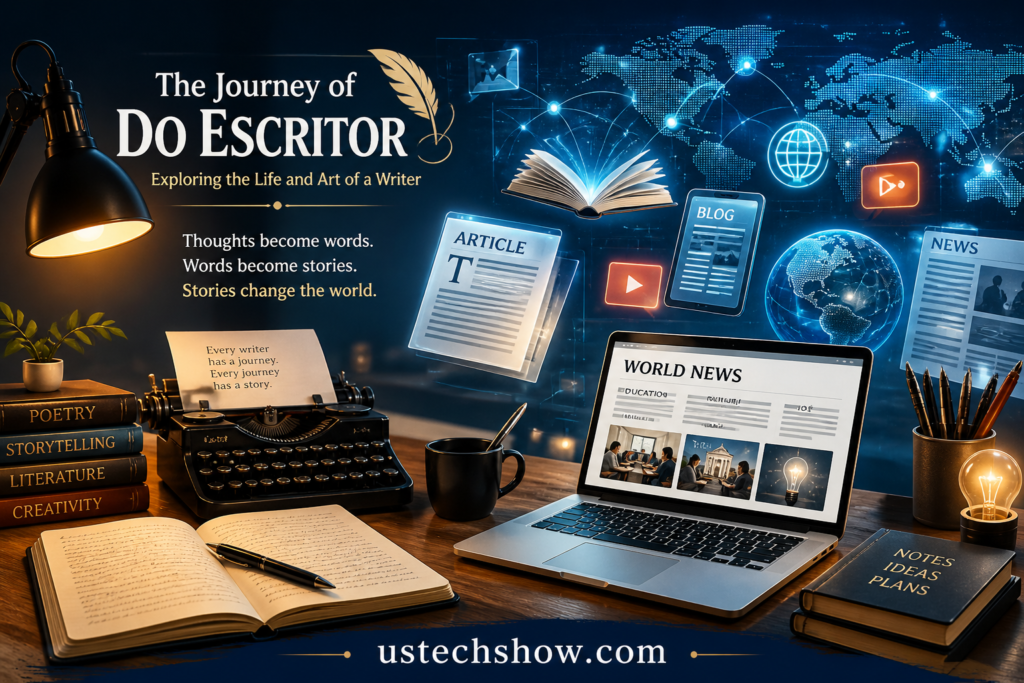

Do Escritor represents the evolving journey of a writer who transforms thoughts into meaningful expression. In today’s world, writing is no longer limited to traditional pages but extends across digital platforms, allowing voices to reach global audiences instantly. This concept highlights the blend of creativity, identity, and communication that defines modern authorship. A writer is not just someone who produces text, but a storyteller who shapes ideas, emotions, and perspectives into impactful narratives.
The journey of Do Escritor reflects continuous learning, imagination, and adaptation in an ever-changing literary landscape. It celebrates how writers connect cultures, inspire dialogue, and contribute to knowledge through their unique expressions while redefining the essence of storytelling in the modern digital age and global communication networks.
Understanding the Meaning Behind “Escritor” in Simple Terms
The term ‘escritor’ is indeed translated as ‘writer’ in English, but its meaning holds much more than a mere definition. The essence of an escritor is that of a creator, one who can think and dream, see and feel through the written word.
And like imagination and the artistic voice, closely associated with this term are: Unimaginative. From beginning to end, it is not simply writing words, but crafting emotions and experience into stories that keep readers feeling.
Is being an escritor really all that admirable in many cultures? That is to say, it is an essential connection with storytelling, and the fact that the writer can use language as a medium of strong communication and expression.
In a world of novelists, essayists and columnists, each and every one sees things differently. And it’s this uniqueness that allows writers to change minds, provoke debates, and have lasting effects on culture over the years.
Linguistic Breakdown of the Phrase “Do Escritor”
The phrase “Do Escritor” has a rich linguistic history that layers its meaning. The term escritor means “writer” in English. From a Latin word meaning to write.” This historic origin puts writing at the heart of what a word means when we say “writer”.
Then there’s “do,” which lies between you and me like a preposition: a conjoining term that roughly translates as “of” or “from,” and it twists the phrase inside itself with intimacy and affiliation. Are you referring to a writer when you add the two words together, but a writer who is nearer the work of writing?
in terms of linguistic analysis, this is how language shapes literary identity. Every part of the phrase means something—it embodies cultural complexity and personal agency. Reflect how writers are not just defined by their work, but by their linkage to creativity and telling stories.
The Connection Between Do Escritor and Literary Expression
In the end “Do Escritor” is the story of the writer and the writing. This is a process that involves more than just writing lines of writing – it is a pilgrimage during which the writer’s feelings, memories and life experiences meld with those of other people.
Writers seem to have a unique ability to take their innermost musings and transform them into tales that emotionally engage readers. From this vantage point Do Escritor shows how writing can express the reality, the challenge and the cultural triumph.
It also connotes the essence of creativity and invention. It encourages writers to look inside themselves for ideas and perspectives that could relate to narrative.
In that respect Do Escritor is far more than a nod to writing. It is the moment at which the ideas of writer and reader meet, speaking to each other in an intimate conversation, adapting both itself and the other through time and culture.
How “Do Escritor” Reflects Writing Identity and Creativity
A escritor, the writer’s true identity. But it’s more than a tag — it’s the passion, the creativity, the gnawing need to string your thoughts together on paper.
And all of the everyday work of art that is produced under this philosophy bears a mark of originality. Writers take their unique worldviews and shape them into compelling narratives that bring us as readers into shared knowledge and emotion.
The mind playing leaps and bounds, and Do Escritor knows how to celebrate this—and so many other—(nationality, genre, style) multiplicities. Any work is a small window to the heart of its maker, and the readers always discover something new, or view something old under a new light.
It enables novelists to be more emotionally candid too. It’s difficult to open yourself up on a personal level, but it adds layers and authenticity to their work. Therein, too, lies every written work is part of a conversation — even if you don’t know who you’re conversing with, across time and space and with strangers — and that makes literature all that much more powerful and alive.
Cultural Value and Influence of the Writer’s Concept
The societal function of the writer is culturally significant. Writers are sometimes considered the voice of their generation, whose ideas and emotions capture and are captured by the masses. Writers lay claim to that tradition in which they serve as keepers of history and identity, chronicling narratives that might otherwise fall prey to erasure.
Their voices can challenge societal norms, mobilize communities and stimulate impactful social movements. Literature is often reflective of society with issues of identity, equality and enlightenment. In this manner, writing transcends the individual sphere, becoming a segment of a collective cultural experience that shapes people’s thinking and doing. Writers unite people across divides through their narratives. They foster empathy by sharing often universal human experiences in unfamiliar contexts. This ongoing interplay of culture and writing is evolving in the era of accelerating change”.
The Role of Do Escritor in Modern Literature and Thought
The relevance of Do Escritor to current writing is both profound and encountering. It serves as underground and above-ground connection to traditional methods of storytelling, and modern creative experimentation; working cooperatively, letting editors and writers push boundaries creatively while respecting the classic narrative roots.
Writers today reach diverse audiences on many platforms and formats. They sometimes combine fact and fantasy to tell tales that resonate at personal and collective levels. This style development enables readers to become more active and contemplative owners of tales.
In its essence, Do Escritor is a reflection of the transitory nature of ideas in our age. Writers challenge established systems and initiate discourse on issues of identity, culture, morality and values of life. Their work may motivate societal change or foster personal reflection.
The concept of what makes someone a writer has expanded even more in the digital age. The accessibility of the online world and social media has generally allowed more voices to be heard, enabling stories to become more diverse and global. This transformation continues to inform the way stories are told, shared, and interpreted among diverse populations.
Where and How the Term “Escritor” Is Commonly Used
“Escritor” is a Spanish and Portuguese word that refers to a writer—someone who converts ideas, feelings, and fantasies into written words in the form of narratives, articles, or poems. It is prevalent in the academic world, in literould discussions and literature in-book.
In the Latin American and European systems of education, many students are confronted with the works of famous escritores. They may take on the roles of mentors and encourage future generations to habilidade and creative itself in writing development.
With the rise of digital communication, the term has also made its way onto the Internet. Many sci-fi authors also describe themselves as escritores in social media to post their work and meet other creative persons worldwide.
Literary events and festivals also underscore the prominence of escritores celebrating their work through readings, talks and cultural exchanges. This expanding network is bridging a broad range of cultures into a deep appreciation for storytelling as a fundamental aspect of human expression.
From traditional publishing ventures to contemporary digital environments, the concepto de un escritor continues to signify the creative, imaginative, ever-changing definition of writing in the 21st century.
Do Escritor in the Digital Age and Online Content Creation
In the era of today’s digital humanity, “Do Escritor” has become more than just a Static Artform. Writers are no longer confined to traditional books or print media; rather, they work as writers on blogs, podcasts, websites and social networking sites, bringing their penmanship to audiences far beyond what they could have previously imagined.
The result is this change in how we communicate opens new doors for writers to talk directly to their readers. Ideas can be disseminated immediately, and responses come just as fast, making writing a more interactive and fun process rather than a one way street.
Meanwhile new types of content – video scripts, visual storytelling, and interactive media – are pushing writers to think more flexibly and creatively. They need to keep shifting the tone and rhythm to grab attention in a rapidly changing digital world.
Newspaper publishers have also made authorship more democratic with modern publishing tools such as content management systems and social media. Now, just about anyone can become a Do Escritor, breaking down the walls that once kept so many locked away from sharing their story.
With technology changing the landscape even further, writers have an even bigger impact on the culture of the Internet and the conversation worldwide. Your path continues to develop as you find more ways to reach, move and captivate readers worldwide.
Why Authorship Matters in Today’s Writing Landscape
Authoring has a multifaceted meaning in today world of writing and environment. While the advent of the digital age has brought accessibility for everyone to be content creators, the lines between original content and ownership has become blurred.
In the era of incessant information, a singular authorial voice is a powerful thing. It adds authenticity and resonance with readers who want to consume real and rich manifestations. To assert authorship is also to an extent assume accountability for the ideas and viewpoints that are expressed through writing.
Concurrently, the promotion of authorship is in the equal part linked with safeguarding the right to creativity. Given the growing threats of theft of content on the internet, they need to remain vigilant and protect their intellectual output.
Who the author is is a question that goes much further than the text. It’s about forming consciousness and getting people to think, and participating in cultural exchange. Every article has the power to spark debate or prompt reform in society.
In this changing digital world, authorship is celebrated as a value with its own cultural capital that allows for differentiation in terms of quality from the mass production. It contributes to maintaining uniqueness and the regeneration of creativity as an integral element of contemporary literature.
The Importance of Critical Thinking in Writing Practice
Thinking critically is part of what makes writing good and good writing critical. It provides an opportunity for writers to think critically about their own writing and obtain deeper knowledge about complex topics, so as to enrich the meaning and develop new content.
Applying critical thinking as a writer means questioning instead of agreeing with first thoughts. They consider different perspectives, allowing them to be more creative, original, and insightful.
This mode of thinking lends clarity to the writing as well. When Authors Think Critically… When I tell a group of students I am writing this information down for them, they sigh and moan. And yet there is nothing really new within the work of these writers in terms of where they focus their thoughts and attention: The power of thought thinking critically is what makes their writing excellent.
Another great benefit is a decreased bias. Using facts and evidence that has been critically evaluated, writers can discuss more nuanced, balanced arguments rather than presenting opinion with only one side of the story. This not only adds depth and color to their work, but it also makes it far more trustworthy and informative.
In conclusion, critical thinking as part of writing process promotes attentive living and life writing, and through this, strives for a richer and more meaningful life living and life writing literature; it enhances writing, and encourages rather a more engaging and thoughtful engagement with readers, and as a result it leads to a higher quality of communication.
Practical Uses of Writing Concepts in Communication and Media
Writing style is an important factor in communication, which on the part of the media influences the communication style within media. They shape the ways in which concepts are articulated and how well different audiences can comprehend them.
Besides, storytelling is one of the strongest elements of writing. Storytelling captures attention and creates emotional connections, which can lead readers and viewers to engage more deeply with any shared message whether in advertising, journalism or digital content.
Clarity is an other essential feature of good writing. Simple, straightforward writing makes it easier to glean the point, particularly in an age of tweets and dwindling attention spans.
Knowing your audience, again, is critical to engagement. There is more interaction and less demonstration when writing is tailored to the readers’ needs and interests.
Furthermore, it can influence opinion and motivate people to take certain actions. Through the use of powerful words and techniques of writing such as metaphors, alliteration or assonance, writers can make their words more persuasive and when they are in writing, it’s definitely more impactful.
From blogs and podcasts to social platforms, writing remains a powerful force in shaping how we think and what we do. In short, consideration of writing principles enables communication to be more meaningful, more effective, and more enduring.
The Evolving Meaning of Do Escritor in Contemporary Context
The idea of “Dos Escritor” was recalibrated in contemporary times. As literature and communications progress and evolve, what is expected of a writer has come to mean so much more than the traditional definitions. As digital technology advanced, authorship was reshaped by whom could become an author and who’s voice would be heard.
For today, Do Escritor says more than ink on paper. It exemplifies how versatile ideas can be shared via different digital formats. As well as books, writers now demonstrate their creativity on blogs, social media posts, podcasts, videos and visual storytelling – and receive recognition and remuneration for their work from a much broader array of audiences.
Cultural transformation has also altered who writes. They are more likely to be identified as thinkers and opinion leaders, challenging accepted wisdom and motivating us to think differently. This change in emphasis is between imagination and originality as the markers of contemporary writing.
In this context, Do Escritor is more than just writing. It’s about sharing ideas with communities, stimulating dialogue, and developing new ways to tell stories. All writers, after all, are part of the larger story in which each voice contributes to the depth, breadth, and diversity of the literary world.
FAQs About Do Escritor
What does “Do Escritor” mean in modern writing?
“Do Escritor” represents the evolving identity of a writer who expresses ideas, emotions, and creativity across both traditional and digital platforms.
How is an “escritor” different from a normal writer?
An escritor is not just someone who writes text, but a creative thinker who transforms experiences and imagination into meaningful storytelling.
Why is Do Escritor important in today’s digital world?
It reflects how writers now use blogs, social media, and multimedia tools to reach global audiences and share ideas instantly.
Can anyone become a Do Escritor in the modern era?
Yes, with digital tools and online platforms, almost anyone can express themselves and take on the identity of a modern writer.
How does Do Escritor connect culture and storytelling?
It helps writers share cultural values, personal experiences, and universal emotions that build understanding between different communities.
What role does creativity play in being an escritor?
Creativity is the core of an escritor, allowing writers to shape unique stories, perspectives, and emotional connections with readers.
How has the meaning of Do Escritor changed over time?
It has evolved from traditional writing on paper to a broader concept that includes digital expression, global communication, and multimedia storytelling.